
A digital platform for cultural and artistic exploration of human condition.
Interview with Jaime Sainz - Let Sound Be My Compass.
This interview is the fourth part of a series of episodes written and created by Sophie Sound, the brainchild of sound designer and sound artist Sophie Kuebler. The second part of this interview features an analysis of a scene in The Sandcastle, where Sophie and Jaime dive deep into the decisions behind the sound design and the sound elements used to tell the story.
I first met Jaime Sainz in Mexico City, where he was one of the first people in post-production to review my sessions and give me feedback. Originally from Orizaba, Mexico, Jaime describes himself as a “failed musician” who ultimately found his place as a Supervising Sound Editor. He recently completed his first film in that role: The Sand Castle, the first feature film by American Director Matty Brown (which we’ll analyze in depth in the second part of this Episode.)
As a kid, Jaime was passionate about music and dreamt of becoming a musician. His father, though supportive, urged him to find a career that could provide stability.
“I was searching for a career when I discovered music and audio production. I thought, ‘Okay, this is cool. I’ll learn how to record music, play in a band, and understand microphones and studios.’” Jaime recalls.
And he lived happily ever after…
Well, wouldn’t that be boring? …
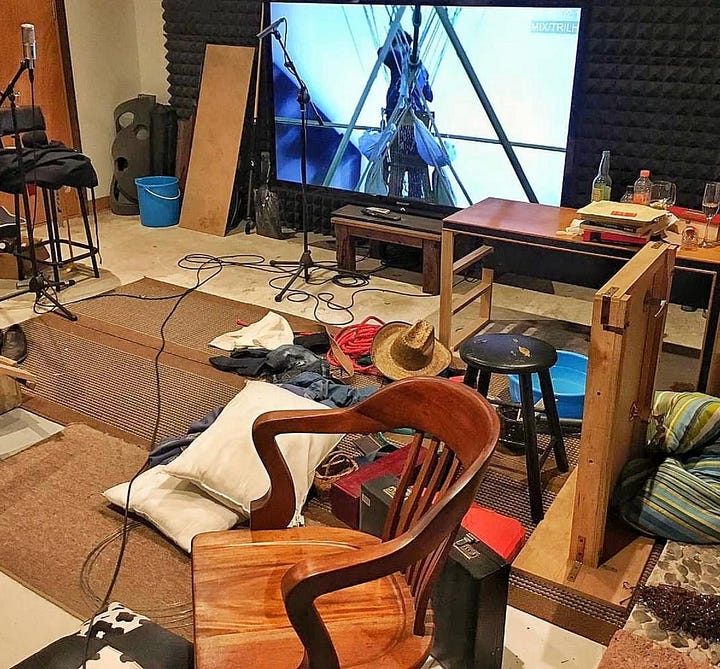
After winning a scholarship to the Vancouver Film School, Jaime moves to Canada in 2012. There, he sharpens his skills and builds a strong bond with fellow Mexican scholar Alan Romero who later becomes his partner of a shared Foley Studio Project that will get them into the Feature Film Olymp. But before that, he studies Sound Design in Canada.
After graduating in Jaime takes on every gig he can find to survive and feed his hunger for Sound. A Craiglist Gig to ADR a French Soap Opera keeps him afloat in Canada. “So what I would do when the French guy, Jean-Didier would come to record ADR, is that I would grab my mattresses and the bed frame and everything, and I would create a recording booth, with a microphone and a monitor inside. It actually absorbed the sound from his voice very well and isolated the exterior sounds in the apartment.
But then soon after, his visa runs out. Trying to find a job to renew it, the plan is to send out applications to loads of companies including Capcom, a video game company in Vancouver.
“But I couldn’t land a job at Capcom that I really hoped to get and that I needed in order to extend my visa to stay in Canada. My visa just expired and I had to go back to Mexico. I was heartbroken and disappointed.”
I sometimes forget that the position Jaime managed to work himself into today, doesn’t come easy. Peter Handke says in one of this thoughts: “Ich werde mich entschlossen verirren.” which translates to “I will decisively get lost.”
J: “Terrible, terrible. I was two years freelancing, and I would send emails. I would send emails to a lot(!) of studios, and nobody would answer me back. I would even tell them, like, you don't have to pay me. I would do it for free. Just teach me. Just give me the opportunity!.. I don't know if maybe the emails went to the spam inbox or whatever, or maybe they were like just, they didn't have a space. No one would reply.”
S: What changed?
J: Back in those 2013/2014 days, I remember that we had a Master Class in Vancouver Film School with Robbie Elias, who now is the lead sound designer at sledgehammer Games, and he has done all the Halo franchise. He's on the VFS alumni.
S: So, he played a big role in this?
J: He was saying that he spent like two or three years without any job, and he thought about quitting. Yeah.
He said, “That's it. I can't do this anymore because I need to earn some money, you know? And as much as I love sound, I cannot continue with this because it's heartbreaking.” And one day, a friend of him called him and said like, “Hey, there's a position to work here in Microsoft in Seattle. Do you want to come?” That's how he started his journey nowadays. He's a successful lead sound designer of the Halo franchise. So with that in mind, that helped me to go on, like, even though I didn't land anything in those years."
That struggle feels all too familiar to me. But then, a turning point, that sounds like a manifestation of Elias’s story and determination.
“Alan, the same friend who studied with me in Vancouver called me, and he said like, “there's this opportunity to record Foley for this Netflix series in Mexico called ‘Club de Cuervos’.” Jaime tells me.
I love that series.
J: The first season was on and they needed a Foley team for the second season. They hired Alan… and Alan called me…
The rock started rolling.
“Yes, because Alan and me - besides being very, very good friends - our work dynamic was super simple. The communication was perfect. It was super smooth. We reached a point where we would not talk because we knew what to do, you know?“
Until…
J: One day, we got a call. They told us about a new movie and said, “It’s from Alfonso Cuarón, and they want to try you out as a Foley team.” Alan and me. And we said like, “yeah, sure.” I was super scared, honestly, because it's like, man, this Alfonso Cuarón, he's a genius, Children of Man, you know? And then they gave us the scene of…
…did you watch the movie?
S: A long time ago, but yes, I watched it.
J: Okay, there's this scene where they are in the forest and there's a fire and a lot of children grab buckets with water and they start putting out the fires. And then this priest dressed up as a, whatever it was, comes in front of the camera and starts singing a song, a song like, I don't know what kind of song.
As a kid, Jaime was passionate about music and dreamt of becoming a musician. His father, though supportive, urged him to find a career that could provide stability.
“I was searching for a career when I discovered music and audio production. I thought, ‘Okay, this is cool. I’ll learn how to record music, play in a band, and understand microphones and studios.’” Jaime recalls.
And he lived happily ever after…
Well, wouldn’t that be boring? …
After winning a scholarship to the Vancouver Film School, Jaime moves to Canada in 2012. There, he sharpens his skills and builds a strong bond with fellow Mexican scholar Alan Romero who later becomes his partner of a shared Foley Studio Project that will get them into the Feature Film Olymp. But before that, he studies Sound Design in Canada.
After graduating in Jaime takes on every gig he can find to survive and feed his hunger for Sound. A Craiglist Gig to ADR a French Soap Opera keeps him afloat in Canada. “So what I would do when the French guy, Jean-Didier would come to record ADR, is that I would grab my mattresses and the bed frame and everything, and I would create a recording booth, with a microphone and a monitor inside. It actually absorbed the sound from his voice very well and isolated the exterior sounds in the apartment.
But then soon after, his visa runs out. Trying to find a job to renew it, the plan is to send out applications to loads of companies including Capcom, a video game company in Vancouver.
“But I couldn’t land a job at Capcom that I really hoped to get and that I needed in order to extend my visa to stay in Canada. My visa just expired and I had to go back to Mexico. I was heartbroken and disappointed.”
I sometimes forget that the position Jaime managed to work himself into today, doesn’t come easy. Peter Handke says in one of this thoughts: “Ich werde mich entschlossen verirren.” which translates to “I will decisively get lost.”
J: “Terrible, terrible. I was two years freelancing, and I would send emails. I would send emails to a lot(!) of studios, and nobody would answer me back. I would even tell them, like, you don't have to pay me. I would do it for free. Just teach me. Just give me the opportunity!.. I don't know if maybe the emails went to the spam inbox or whatever, or maybe they were like just, they didn't have a space. No one would reply.”
S: What changed?
J: Back in those 2013/2014 days, I remember that we had a Master Class in Vancouver Film School with Robbie Elias, who now is the lead sound designer at sledgehammer Games, and he has done all the Halo franchise. He's on the VFS alumni.
S: So, he played a big role in this?
J: He was saying that he spent like two or three years without any job, and he thought about quitting. Yeah.
He said, “That's it. I can't do this anymore because I need to earn some money, you know? And as much as I love sound, I cannot continue with this because it's heartbreaking.” And one day, a friend of him called him and said like, “Hey, there's a position to work here in Microsoft in Seattle. Do you want to come?” That's how he started his journey nowadays. He's a successful lead sound designer of the Halo franchise. So with that in mind, that helped me to go on, like, even though I didn't land anything in those years."
That struggle feels all too familiar to me. But then, a turning point, that sounds like a manifestation of Elias’s story and determination.
“Alan, the same friend who studied with me in Vancouver called me, and he said like, “there's this opportunity to record Foley for this Netflix series in Mexico called ‘Club de Cuervos’.” Jaime tells me.
I love that series.
J: The first season was on and they needed a Foley team for the second season. They hired Alan… and Alan called me…
The rock started rolling.
“Yes, because Alan and me - besides being very, very good friends - our work dynamic was super simple. The communication was perfect. It was super smooth. We reached a point where we would not talk because we knew what to do, you know?“
Until…
J: One day, we got a call. They told us about a new movie and said, “It’s from Alfonso Cuarón, and they want to try you out as a Foley team.” Alan and me. And we said like, “yeah, sure.” I was super scared, honestly, because it's like, man, this Alfonso Cuarón, he's a genius, Children of Man, you know? And then they gave us the scene of…
…did you watch the movie?
S: A long time ago, but yes, I watched it.
J: Okay, there's this scene where they are in the forest and there's a fire and a lot of children grab buckets with water and they start putting out the fires. And then this priest dressed up as a, whatever it was, comes in front of the camera and starts singing a song, a song like, I don't know what kind of song.
S: Chaos.
J: Chaotic. 100%. I watched that and I was like, no, man, we're going to die. I don't know if we're going to be able to do this, but we have to. So we went for it.
They landed the job on the later Oscar-winning movie ROMA. And through another strain of luck and good recommendations they land in the ears of Martín Hernández.
J: Chaotic. 100%. I watched that and I was like, no, man, we're going to die. I don't know if we're going to be able to do this, but we have to. So we went for it.
They landed the job on the later Oscar-winning movie ROMA. And through another strain of luck and good recommendations they land in the ears of Martín Hernández.
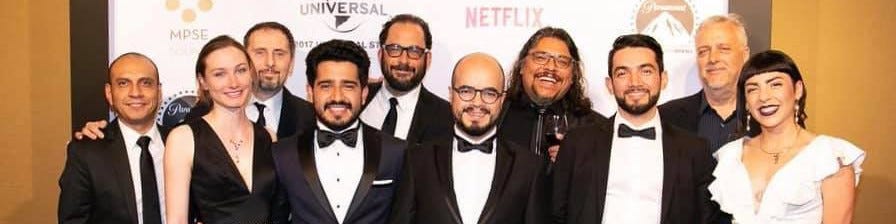
J: We knew about Martín but we never met him, right? And I mean, someone who did The Revenant, Birdman, Amores Perros, Pants Labyrinth. It's intimidating, you know? But he trusted us and made us part of his team at Cinematic Media.
S: And that's where you still are?
J: Yes. For six years now.
…At Cinematic Media in Mexico City where he just finished his first film as Supervising Sound Editor for The Sand Castle.
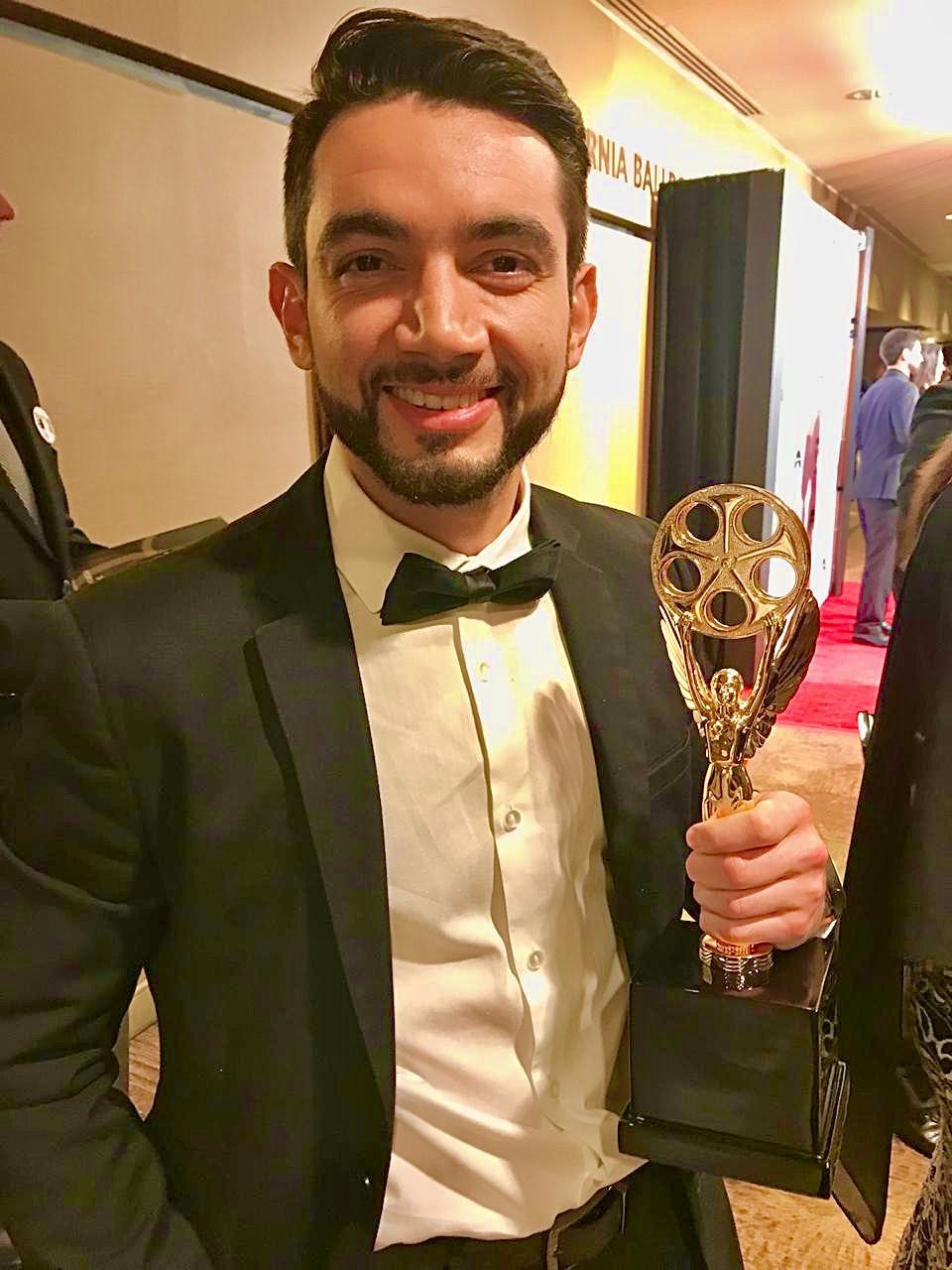
Jaime: Yes, this was my first film as a sound supervisor. The things is, that I had supervised streaming series before, but never a film all by myself.
Sophie Sound: The story is a movie based on war, a family fleeing war I think from Syria and being stranded on an island.
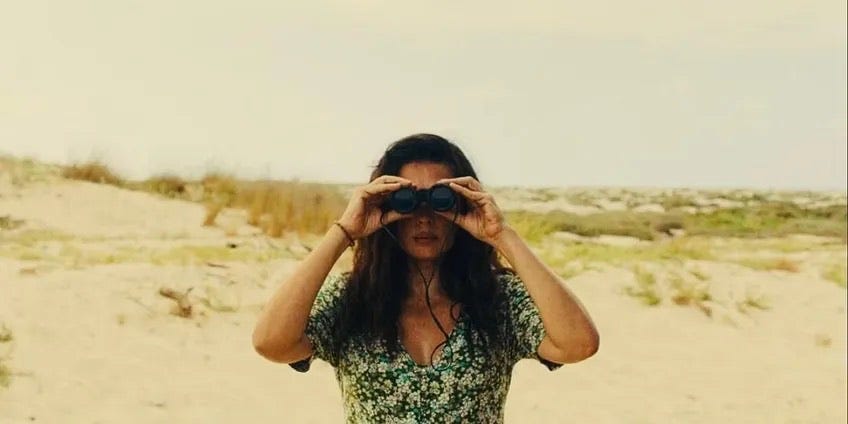
J: Exactly. The core theme is immigration. Nadine Labaki is Lebanese, the children in the film (Zain Al Rafeea & Riman Al Rafeea) are Syrian, and I believe the male lead role Ziad Bakri is Palestinian. The movie never explicitly tells you where they're from or why they ended up there. They're stranded and waiting for someone to pick them up. There are subtle hints throughout the film. For example, when the mother says, "We shouldn't have paid them the full amount without knowing if they'd actually come" you realize they must have paid smugglers to transport them. These small details are scattered throughout the movie, helping the audience piece things together. They never specify where the characters are from, but if I recall correctly, it’s based on a real incident involving Syrian immigrants in the 2000s. A boat carrying refugees capsized while heading toward Greece. You can see a reference to that in the film—there’s a scene where Nadine Labaki’s character looks through binoculars, and you hear a radio broadcast mentioning the Greek government's concerns about a boat that capsized. That event actually happened in real life.
S: Right, I remember this shocking image of a drowned syrian boy who's dead body was whased upon the shore of Bodrum, Turkey trying to reach Greece.
J: Exactly. Most of the movie revolves around that tragedy.
Sophie Sound: The story is a movie based on war, a family fleeing war I think from Syria and being stranded on an island.
J: Exactly. The core theme is immigration. Nadine Labaki is Lebanese, the children in the film (Zain Al Rafeea & Riman Al Rafeea) are Syrian, and I believe the male lead role Ziad Bakri is Palestinian. The movie never explicitly tells you where they're from or why they ended up there. They're stranded and waiting for someone to pick them up. There are subtle hints throughout the film. For example, when the mother says, "We shouldn't have paid them the full amount without knowing if they'd actually come" you realize they must have paid smugglers to transport them. These small details are scattered throughout the movie, helping the audience piece things together. They never specify where the characters are from, but if I recall correctly, it’s based on a real incident involving Syrian immigrants in the 2000s. A boat carrying refugees capsized while heading toward Greece. You can see a reference to that in the film—there’s a scene where Nadine Labaki’s character looks through binoculars, and you hear a radio broadcast mentioning the Greek government's concerns about a boat that capsized. That event actually happened in real life.
S: Right, I remember this shocking image of a drowned syrian boy who's dead body was whased upon the shore of Bodrum, Turkey trying to reach Greece.
J: Exactly. Most of the movie revolves around that tragedy.
S: What struck me when I watched it the second time was how unfortunate it is that the film is only available on Netflix and hasn’t been distributed through independent festivals like Sundance, SXSW etc. Those platforms attract audiences who seek out more thought-provoking content. Movies like this have the power to make people engage emotionally with heavy political topics—something the news can’t always achieve. News coverage tends to be overwhelming and aggressive, while films use storytelling techniques to evoke emotions and help people remember these issues differently. That’s why I think it’s a real loss that this film didn’t get wider exposure. I remember I was lucky enough to sit with you and Matty in the final review session and watched the whole movie and couldn’t hold my emotions together at the end. I was secretly crying. It was too much of a powerful movie and unforgiving storytelling to hold my tears back.
J: Yes, 100% because it is so it is just extremely sad
S: It’s incredibly sad, and the way the film presents the story is so raw. You don’t even need much context because the film doesn’t provide backstories, which. think is perfect because it just presents the reality of that family, on that island as it is. That works perfectly because it reminds you of this massive global problem in a way that everybody knows about. and brings it into something very intimate and immediate, something everyone can understand. And there’s very little dialogue.
J: Exactly. They don't tell you why they got there, you just know that they are stranded and someone is gonna pick them up. But they give you these hints as in Nadine the mother says “we shouldn't have paid them the full amount” without knowing that they were gonna come or not. Also there isn’t much dialogue. The dialogue that is there, is in Arabic, so for people like us—since you speak German and I speak Spanish—we rely on subtitles. A lot of meaning can get lost in translation.
Going back to your point earlier about the films distribution. I don't know whose fault was that because honestly I'm not involved in that, but the publicity was not good because they saw it as if it was a thriller and people were expecting a thriller, but it's a war drama. And there was no promotions other than, okay there's this movie the Sand Castle, what is it about I don't know, but it's just a thriller. I'm surprised that the reactions towards the movie are people either love it or they hate it.
S: Yeah, it’s definitely meant for a niche audience.
J: Exactly. It’s not a film for everyone. It would have been better if they had bought the rights and distributed it more widely, but unfortunately, that didn’t happen.
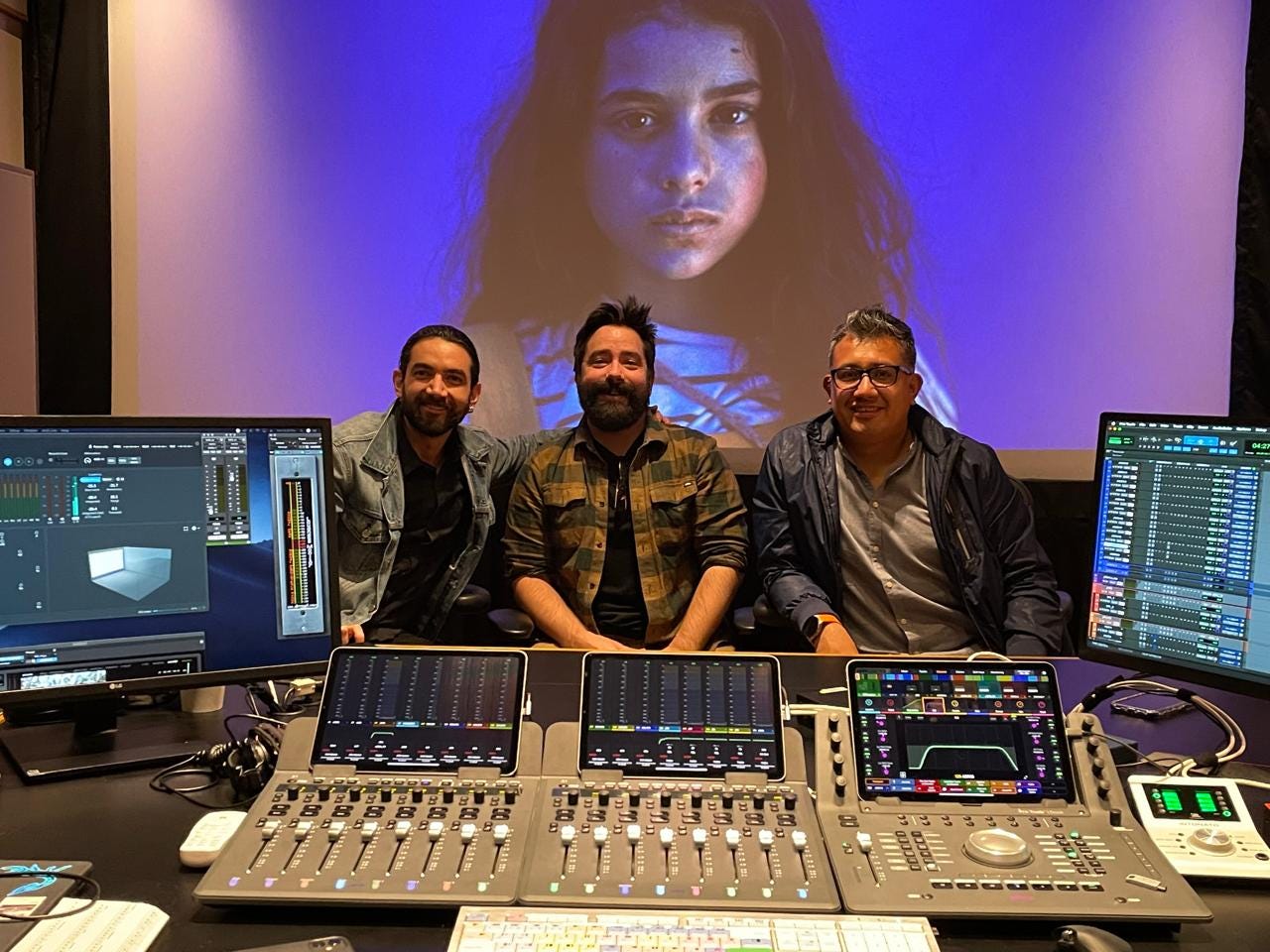 Jaime Sainz, Matty Brown, Daniel Torres at Cinematic Media, Mexico City after the Final Mix for the Sand Castle.
S: So you've been working with Matty and I am curious about how you started working together on the sound ideas. There are specific elements that have a personality, the ocean, the wind, the creeks, big bubbles and I think there's just tons of sound design. For someone that doesn't work with sound, I mean even for me it's not yet possible to understand what sounds I can create like what different combinations I can use in order to make a lighthouse mechanics or machine sound because you can just try out a lot of different things.
J: Since they were based in New York, all communication was done through Zoom calls and emails. When we first got the film, it already had a guide track—this includes temp music, temp sound effects, and the raw dialogue.
when we got the movie it comes with the guide track, temp music, temp sound effects and the raw dialogue. So when we heard and saw the the first draft of the whole movie his idea became very clear. There are scenes where you can see the ocean crashing against the rocks, it looks a National Geographic documentary. Camera Shots underneath in the water, the island from above. Those scenes are amazing but there's so many ways that you can make them sound which you don't know until you get to that part and start experimenting, plus getting the idea of what Matty wants the director. After that first draft we had a call with him and we did a spotting session. The family lives in a lighthouse and that has an engine. The engine has a very particular sound, it's not any engine if you listen to it closely. When I first heard it, I thought, "That sounds like a boat engine." And that was intentional—it was an allegory for their journey. These small details tell the story in a subliminal way.
So, my job was to design an engine sound that didn’t resemble a typical lighthouse motor but also wasn’t obviously a boat engine. Just enough to create that underlying connection without making it too obvious. What I did is, I looked for an interesting-sounding boat engine and a motor that had a similar ‘rpm’ (this one needed to be interesting too!). Finding two different engines which have the same ‘rmp’ is very complicated, so I had to align them manually without altering the natural rhythm of both of them. Finally I used MORPH by Zynaptiq to blend them together and create new sounds.
S: I always wonder how directors work with temp sound. If you’re not familiar with sound design, it must be hard to know what’s possible. There are endless ways of creating sounds. So, how does the process evolve from the temp mix to the final design? Did Matty know exactly what he wanted or did you experiment a lot and then show him your experimentations?
J: Well, that's the challenge. I think creatively it doesn't come only from one person rather from the whole sound team. Something that I really like, when I’m supervising a team, is to give everybody the freedom to experiment and bring ideas to the table that may help the construction of the narrative of the story. As people say “dos cabezas piensan mejor que una.” So I could have an idea for the engine of the lighthouse and the Foley team might bring in some nuances that I might have not thought about, which help the engine come alive. It happens all the time. I thought about the creek of the wood in the floor, something as simple as footsteps right, but I don't know how it's going to sound but I know, it has to sound old, because it’s part of the lighthouse’s character. It's made of wood, you have to make it feel like it's not going to break but it has this quality that the lighthouse speaks itself.
So when the Foley team proposes a sound and I hear it, I immediately know ‘ok that works’ or if it doesn't click with me I try to understand why not and try to understand what is it that it's missing. Either it's not the correct sound or maybe it's not the right shoe.
Matty had a very clear idea of how he wanted his film to sound. He portrayed it perfectly in the guide track but also gave me punctual notes about specific sounds that were really important for him. "The ocean is a character. It’s THE monster in the film." There’s a scene where the little girl talks about the "blue monster" surrounding them. So, we had to give the ocean a threatening voice.
The challenge here though, is that the oceans and wind are both types of white noise.
How do you make something, that can be static or not dynamic, not become boring. So you have to look at when the Ocean is the main character and when it's not?
For example, in the opening scene, the little girl is playing with bones, stones, and shells while talking to her parents. The ocean is still there in the background, but it’s not the focus. You don’t need to make the audience focus on the ocean at that moment. It’s just present.
S: Do you have an example of a scene where the ocean is particularly alive as a character?
J: Let’s check… The radio plays an important role too. Maybe we can find a scene where both elements interact…
If the ocean already has the low frequency, then the wind most likely will be taking care of the high frequencies. The ocean is still there, but it's very low because it's not important anymore.
And then it comes back there. “Hello? Hello? Hello? Can you hear me?” Everything is full with sound effects.
Suddenly, the father starts trying to talk on the radio. You can hear some sounds, but it's static. It sounds like screams. It gets very ominous. It may look like a horror film at the beginning.
The situation that they are involved in at that very moment, is horrifying.
S: And every sound is there because of a purpose.
J: Right. Undoing this yellow thing that we still don't know what it is, she finds something peculiar about it and things start escalating.
When the bomb goes off. When the engine is going up, those hits are explosions. They symbolise the explosions that you can see at the very end of the film in the school. And the actual reason they fled.
And this basically means that the boat's engine blew off. And they are stranded. I'm not gonna say what's gonna happen, but... Everything goes to shit from now on.
And then after you see the... The sand swallowing or whatever the surface is swallowing the sand. It becomes something more poetic.
And you see the son. He goes into the water. It's like a sequence of symbolic happenings. He goes into the water for a reason. He needs to look for food because they don't have food. And the mother doesn't want him to go there because it's dangerous, right? So the sand gets swallowed while the son jumps into the water. Which means the water swallows them.
It's part of the damage that the daughter did here. It's one of the reasons why... We can say spoilers, right? Why the island starts sinking.
S: I often don't know what's surreal and what isn't surreal. Because it just kind of fades into each other until the end. Even with the sound... there are so many hallucinations. And disillusions. Getting lost mentally. Being completely exhausted. Their trauma that reoccurs.
J: We're going right now from reality into a traumatic ending. I know all of this obviously because Matty asked me to do it that way. We crafted the sound around his ideas.
But nothing is real at the very end. The only thing that is real is the very last scene.
For instance, there was never an island. It's sinking right now. It's because a hole was made into the boat. That was the island. The island is the boat. The water comes. That's all symbolic.
It's a really hard movie to comprehend at first glance It's a movie that you have to watch a couple of times to understand what's happening.
S: I love these type of movies where you keep unpeeling meaning after meaning. Especially when it is that well narrated, and the ideas interwoven.
-
S: If that was the first time. Being a supervising sound editor. What did it teach you? And what were challenges?
J: Prepare everything thoroughly. It became one of the biggest challenges I’ve ever faced. Being able to do whatever we believed was best for the movie. Fortunately, the director gave us the freedom to explore that. The theme of immigration was especially meaningful to me and it was a fantastic experience through which I learned so much about the subject, about the language, and about different perspectives.Working on this project, getting to know Matty, collaborating with him and both teams in the USA and Lebanon, all of these aspects were all incredibly enriching. In the end, it was a very rewarding experience for me in all senses.
J: Yes, 100% because it is so it is just extremely sad
S: It’s incredibly sad, and the way the film presents the story is so raw. You don’t even need much context because the film doesn’t provide backstories, which. think is perfect because it just presents the reality of that family, on that island as it is. That works perfectly because it reminds you of this massive global problem in a way that everybody knows about. and brings it into something very intimate and immediate, something everyone can understand. And there’s very little dialogue.
J: Exactly. They don't tell you why they got there, you just know that they are stranded and someone is gonna pick them up. But they give you these hints as in Nadine the mother says “we shouldn't have paid them the full amount” without knowing that they were gonna come or not. Also there isn’t much dialogue. The dialogue that is there, is in Arabic, so for people like us—since you speak German and I speak Spanish—we rely on subtitles. A lot of meaning can get lost in translation.
Going back to your point earlier about the films distribution. I don't know whose fault was that because honestly I'm not involved in that, but the publicity was not good because they saw it as if it was a thriller and people were expecting a thriller, but it's a war drama. And there was no promotions other than, okay there's this movie the Sand Castle, what is it about I don't know, but it's just a thriller. I'm surprised that the reactions towards the movie are people either love it or they hate it.
S: Yeah, it’s definitely meant for a niche audience.
J: Exactly. It’s not a film for everyone. It would have been better if they had bought the rights and distributed it more widely, but unfortunately, that didn’t happen.
 Jaime Sainz, Matty Brown, Daniel Torres at Cinematic Media, Mexico City after the Final Mix for the Sand Castle.
S: So you've been working with Matty and I am curious about how you started working together on the sound ideas. There are specific elements that have a personality, the ocean, the wind, the creeks, big bubbles and I think there's just tons of sound design. For someone that doesn't work with sound, I mean even for me it's not yet possible to understand what sounds I can create like what different combinations I can use in order to make a lighthouse mechanics or machine sound because you can just try out a lot of different things.
J: Since they were based in New York, all communication was done through Zoom calls and emails. When we first got the film, it already had a guide track—this includes temp music, temp sound effects, and the raw dialogue.
when we got the movie it comes with the guide track, temp music, temp sound effects and the raw dialogue. So when we heard and saw the the first draft of the whole movie his idea became very clear. There are scenes where you can see the ocean crashing against the rocks, it looks a National Geographic documentary. Camera Shots underneath in the water, the island from above. Those scenes are amazing but there's so many ways that you can make them sound which you don't know until you get to that part and start experimenting, plus getting the idea of what Matty wants the director. After that first draft we had a call with him and we did a spotting session. The family lives in a lighthouse and that has an engine. The engine has a very particular sound, it's not any engine if you listen to it closely. When I first heard it, I thought, "That sounds like a boat engine." And that was intentional—it was an allegory for their journey. These small details tell the story in a subliminal way.
So, my job was to design an engine sound that didn’t resemble a typical lighthouse motor but also wasn’t obviously a boat engine. Just enough to create that underlying connection without making it too obvious. What I did is, I looked for an interesting-sounding boat engine and a motor that had a similar ‘rpm’ (this one needed to be interesting too!). Finding two different engines which have the same ‘rmp’ is very complicated, so I had to align them manually without altering the natural rhythm of both of them. Finally I used MORPH by Zynaptiq to blend them together and create new sounds.
S: I always wonder how directors work with temp sound. If you’re not familiar with sound design, it must be hard to know what’s possible. There are endless ways of creating sounds. So, how does the process evolve from the temp mix to the final design? Did Matty know exactly what he wanted or did you experiment a lot and then show him your experimentations?
J: Well, that's the challenge. I think creatively it doesn't come only from one person rather from the whole sound team. Something that I really like, when I’m supervising a team, is to give everybody the freedom to experiment and bring ideas to the table that may help the construction of the narrative of the story. As people say “dos cabezas piensan mejor que una.” So I could have an idea for the engine of the lighthouse and the Foley team might bring in some nuances that I might have not thought about, which help the engine come alive. It happens all the time. I thought about the creek of the wood in the floor, something as simple as footsteps right, but I don't know how it's going to sound but I know, it has to sound old, because it’s part of the lighthouse’s character. It's made of wood, you have to make it feel like it's not going to break but it has this quality that the lighthouse speaks itself.
So when the Foley team proposes a sound and I hear it, I immediately know ‘ok that works’ or if it doesn't click with me I try to understand why not and try to understand what is it that it's missing. Either it's not the correct sound or maybe it's not the right shoe.
Matty had a very clear idea of how he wanted his film to sound. He portrayed it perfectly in the guide track but also gave me punctual notes about specific sounds that were really important for him. "The ocean is a character. It’s THE monster in the film." There’s a scene where the little girl talks about the "blue monster" surrounding them. So, we had to give the ocean a threatening voice.
The challenge here though, is that the oceans and wind are both types of white noise.
How do you make something, that can be static or not dynamic, not become boring. So you have to look at when the Ocean is the main character and when it's not?
For example, in the opening scene, the little girl is playing with bones, stones, and shells while talking to her parents. The ocean is still there in the background, but it’s not the focus. You don’t need to make the audience focus on the ocean at that moment. It’s just present.
S: Do you have an example of a scene where the ocean is particularly alive as a character?
J: Let’s check… The radio plays an important role too. Maybe we can find a scene where both elements interact…
If the ocean already has the low frequency, then the wind most likely will be taking care of the high frequencies. The ocean is still there, but it's very low because it's not important anymore.
And then it comes back there. “Hello? Hello? Hello? Can you hear me?” Everything is full with sound effects.
Suddenly, the father starts trying to talk on the radio. You can hear some sounds, but it's static. It sounds like screams. It gets very ominous. It may look like a horror film at the beginning.
The situation that they are involved in at that very moment, is horrifying.
S: And every sound is there because of a purpose.
J: Right. Undoing this yellow thing that we still don't know what it is, she finds something peculiar about it and things start escalating.
When the bomb goes off. When the engine is going up, those hits are explosions. They symbolise the explosions that you can see at the very end of the film in the school. And the actual reason they fled.
And this basically means that the boat's engine blew off. And they are stranded. I'm not gonna say what's gonna happen, but... Everything goes to shit from now on.
And then after you see the... The sand swallowing or whatever the surface is swallowing the sand. It becomes something more poetic.
And you see the son. He goes into the water. It's like a sequence of symbolic happenings. He goes into the water for a reason. He needs to look for food because they don't have food. And the mother doesn't want him to go there because it's dangerous, right? So the sand gets swallowed while the son jumps into the water. Which means the water swallows them.
It's part of the damage that the daughter did here. It's one of the reasons why... We can say spoilers, right? Why the island starts sinking.
S: I often don't know what's surreal and what isn't surreal. Because it just kind of fades into each other until the end. Even with the sound... there are so many hallucinations. And disillusions. Getting lost mentally. Being completely exhausted. Their trauma that reoccurs.
J: We're going right now from reality into a traumatic ending. I know all of this obviously because Matty asked me to do it that way. We crafted the sound around his ideas.
But nothing is real at the very end. The only thing that is real is the very last scene.
For instance, there was never an island. It's sinking right now. It's because a hole was made into the boat. That was the island. The island is the boat. The water comes. That's all symbolic.
It's a really hard movie to comprehend at first glance It's a movie that you have to watch a couple of times to understand what's happening.
S: I love these type of movies where you keep unpeeling meaning after meaning. Especially when it is that well narrated, and the ideas interwoven.
-
S: If that was the first time. Being a supervising sound editor. What did it teach you? And what were challenges?
J: Prepare everything thoroughly. It became one of the biggest challenges I’ve ever faced. Being able to do whatever we believed was best for the movie. Fortunately, the director gave us the freedom to explore that. The theme of immigration was especially meaningful to me and it was a fantastic experience through which I learned so much about the subject, about the language, and about different perspectives.Working on this project, getting to know Matty, collaborating with him and both teams in the USA and Lebanon, all of these aspects were all incredibly enriching. In the end, it was a very rewarding experience for me in all senses.